In his final years, after his departure from the Communist Party, Attila József was welcomed by the group of radical-progressive writers (Pál Ignotus and his circle), with whom he became close during the so-called népi–urbánus vita [the debate between “populist” or “folk” writers and the “urban”, progressive writers]. Together they launched the magazine Szép Szó [Beautiful Word] at the end of 1935, of which Attila József became co-editor-in-chief with Ignotus. The literary and social science journal, which was active between 1936 and 1939, did not outlive the poet for long, as its left-liberal ethos became less and less in tune with the prevailing ideology of the period. As the Attila József-researcher, György Tverdota wrote on the occasion of the seventy-fifth anniversary of the launch of the journal, “The poems, short stories, essays, studies, reviews and articles, the sparkling debates published in the journal testify to lasting literary values—and not only those of Attila József. The journal covered topics that are still considered as sensitive topics even today: socialism, leftism, different models and interpretations of liberalism, the nature of the capitalist system, fascism and race theory, the so-called népi-urbánus debate, Freudianism, the national tradition, the literary canon, etc. This thematic, conceptual and aesthetic richness is so up-to-date, that, ‘unfortunately’, it is easy to compile such a collection of quotations from the journal’s texts that is still strikingly topical in 2011.” One of these texts, which is still worth re-reading in 2021, is Attila József’s Szerkesztői üzenet [Editor’s Note], published in the second issue of the journal. The Editor’s Note is, on the one hand, a message written to one of his deeply religious friends and constant debating partners, István Barta, but it is in fact a summary of Attila József’s artistic thinking and the mission statement of Szép Szó, in which he speaks out in favor of artistic freedom, reason, “persuasion, mutual recognition and discussion of human interests”, in an age in which there was less and less room for these ideas.
Editor's Note
Szép Szó [Beautiful Word], 1936:2, excerpts
“You are enthusiastic about the ideal of order, but what you really mean is an ‘orderly state’. But you, who are looking at it from the point of view of moral freedom, must know that order can only express itself on the grounds of freedom and in freedom. […] Finally, you object to the title of this journal. BEAUTIFUL WORD—a phrase which, in your eyes, ‘degrades’ our thoughts into a child’s play in an age of ‘moral regeneration’. I do not see why play or the joy of children, should be inferior. I feel like a child in my happy moments, and my heart is light when I discover play in my work. I am afraid of people who do not know how to play, and I will always strive to ensure that people’s playfulness is not diminished, and that the scanty conditions of life, which discourage and spoil playfulness, are eliminated. In the climate of dictatorships, it is fashionable to denigrate as ‘beautiful or fine words’ all the manifestations of intellectual humanism which have been brought to light by a great deal of suffering and effort and which float before us as principles of our culture. When we want to express, with beautiful words, the human consciousness that the violence— that is taking place all over the world—is forcing into the depths of souls, we cannot acknowledge the spiritual superiority of violence by running away from the beautiful word it mocks. We are willing to endure this mockery. ‘Beautiful word’ in Hungarian does not mean a polished, well-ornated expression, but an embodied argument. The beautiful word is not only our tool, but also our goal. Our goal is a social and public way of life, in which the beautiful word, persuasion, mutual recognition and discussion of human interests, and the idea of interdependence prevail. With our actions, writings, thoughts, and our beliefs in reason, we try to awaken the need for human unity, the need for a more advanced unity than the old ones: the modern, self-disciplining, ‘orderly’ freedom.”
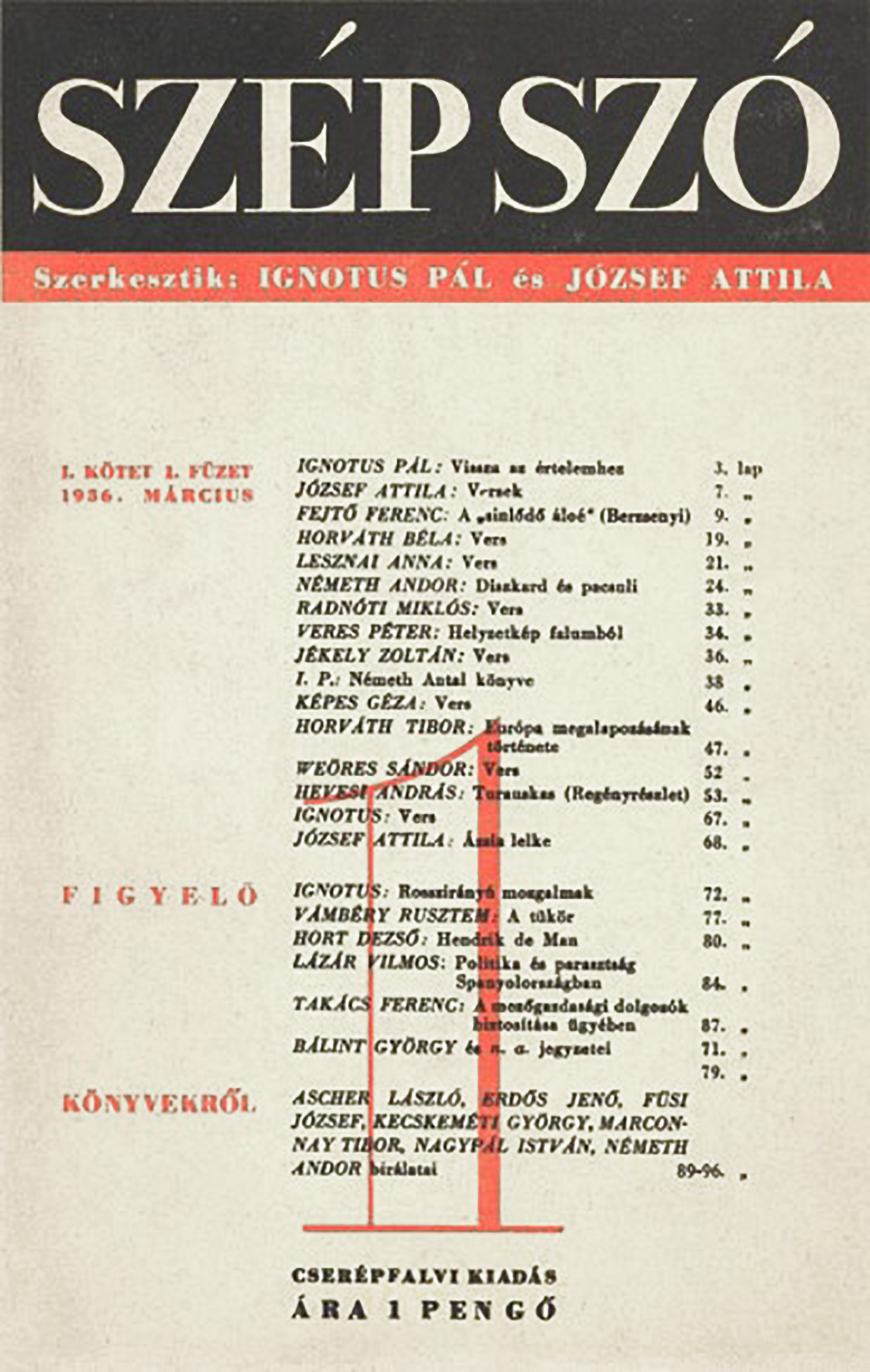
The first issue of the literary journal Szép Szó [Beautiful Word], 1936
private collection, Budapest
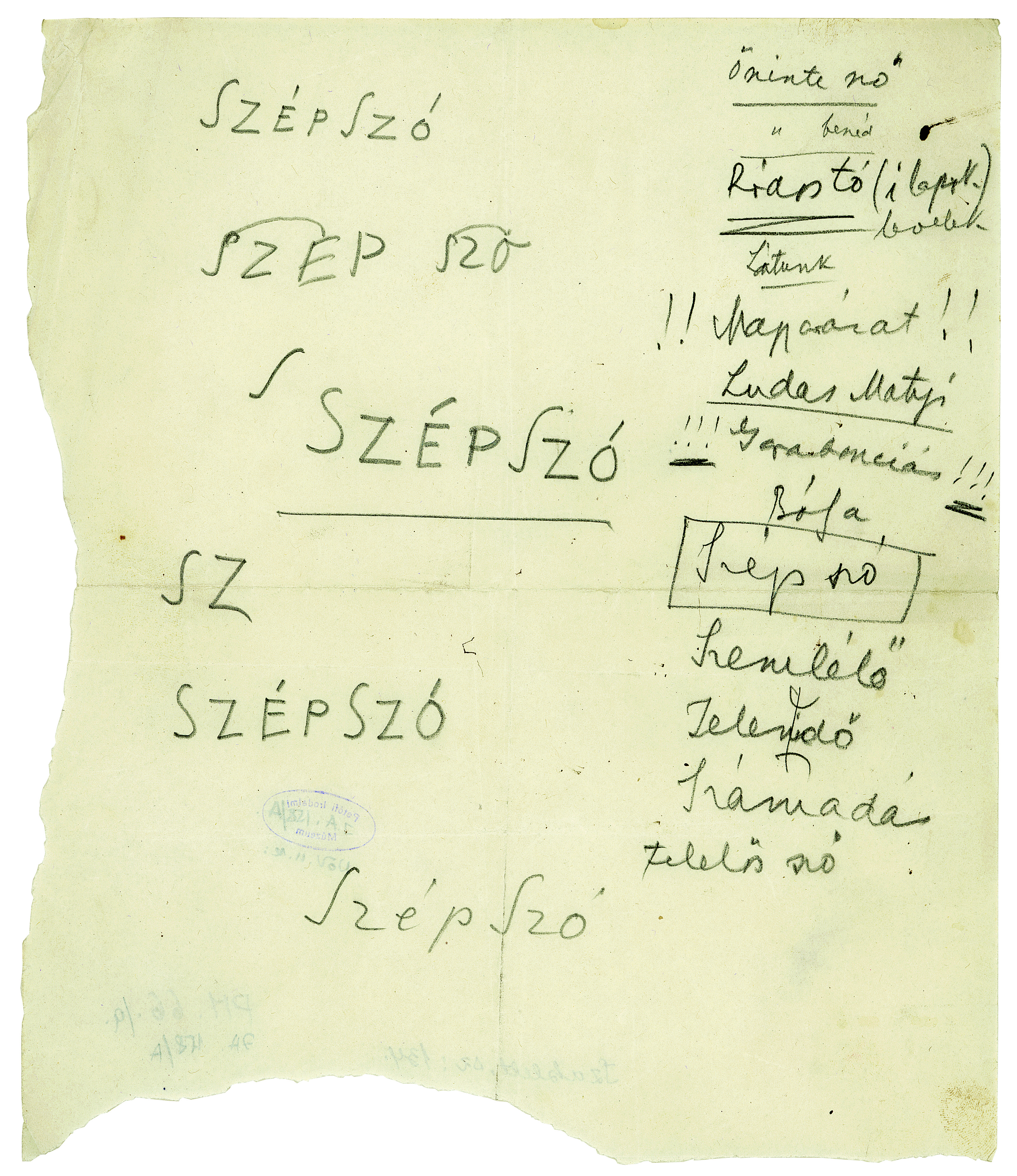
Title ideas by Attila József for the literary journal Szép Szó [Beautiful Word], 1935
autograph pencil writing, exhibition print
Petőfi Literary Museum – Manuscript Collection, Budapest
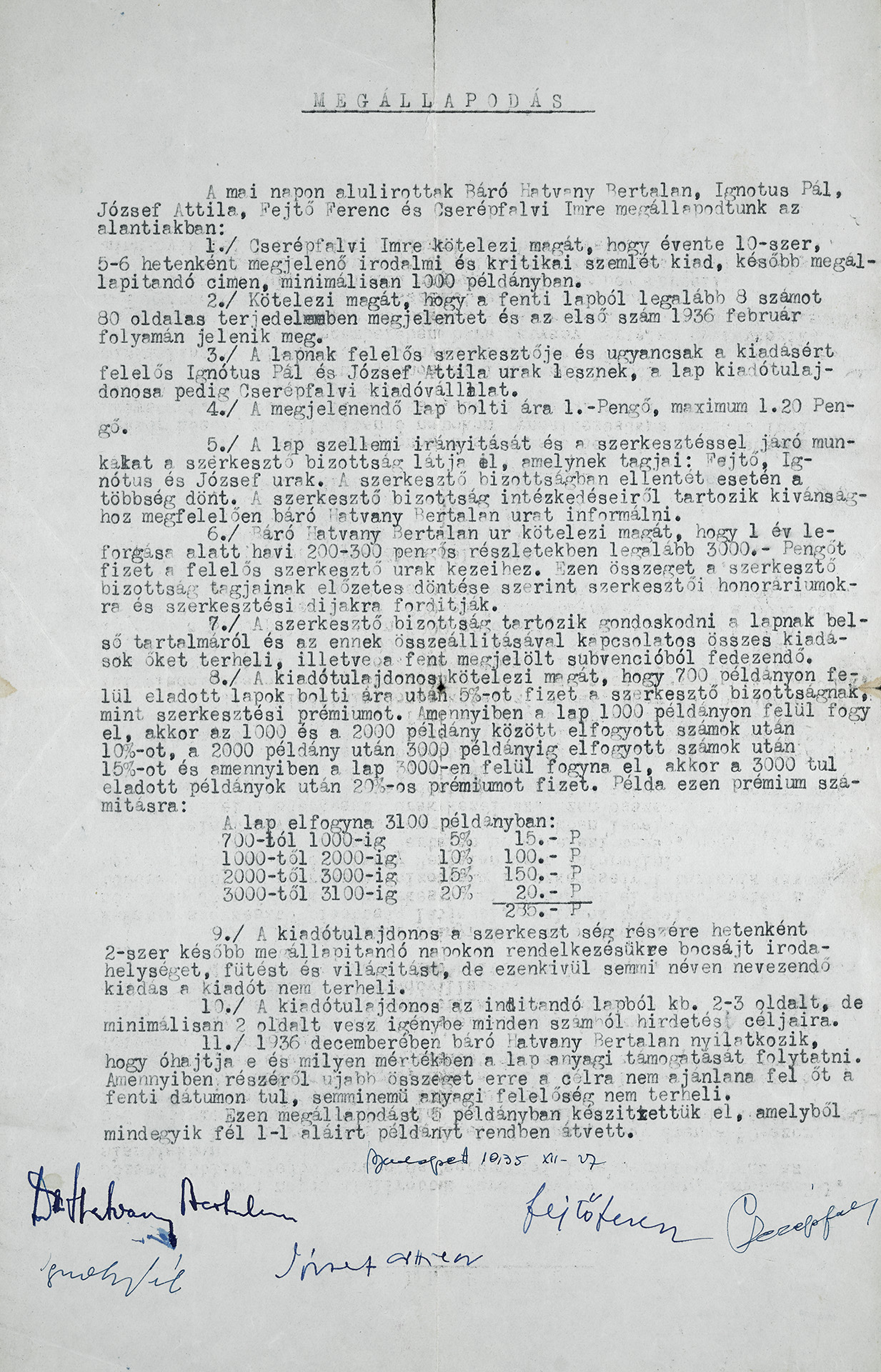
Attila József’s agreement with the Cserépfalvi publishing house on the launch of the literary journal Szép Szó [Beautiful word], December 27, 1935
typescript, signed, exhibition print
Petőfi Literary Museum – Manuscript Collection, Budapest
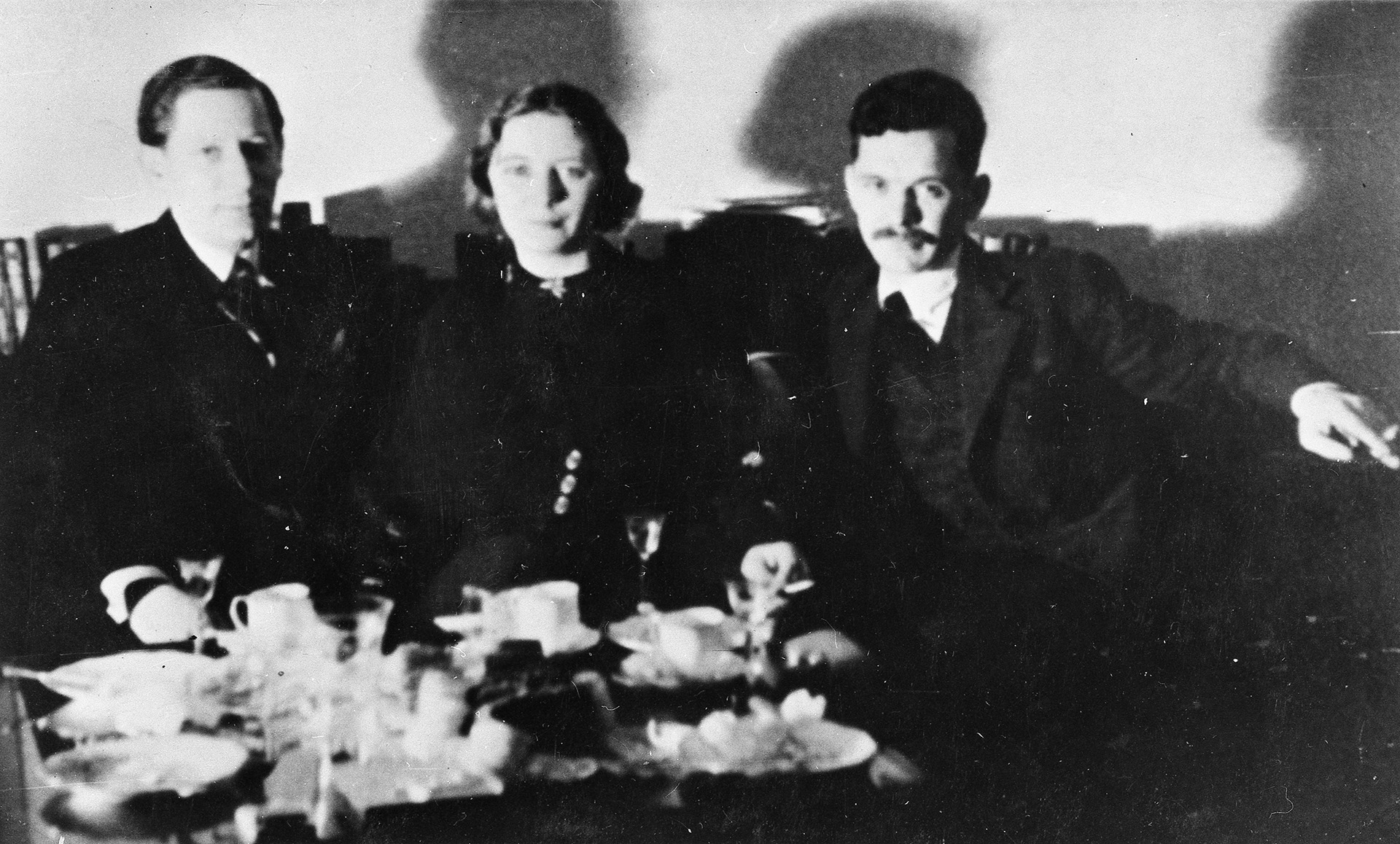
Attila József, Judit Szántó and István Barta, at István Barta’s, 1935
bw. photo, exhibition print
Petőfi Literary Museum – Photo Collection, Budapest